
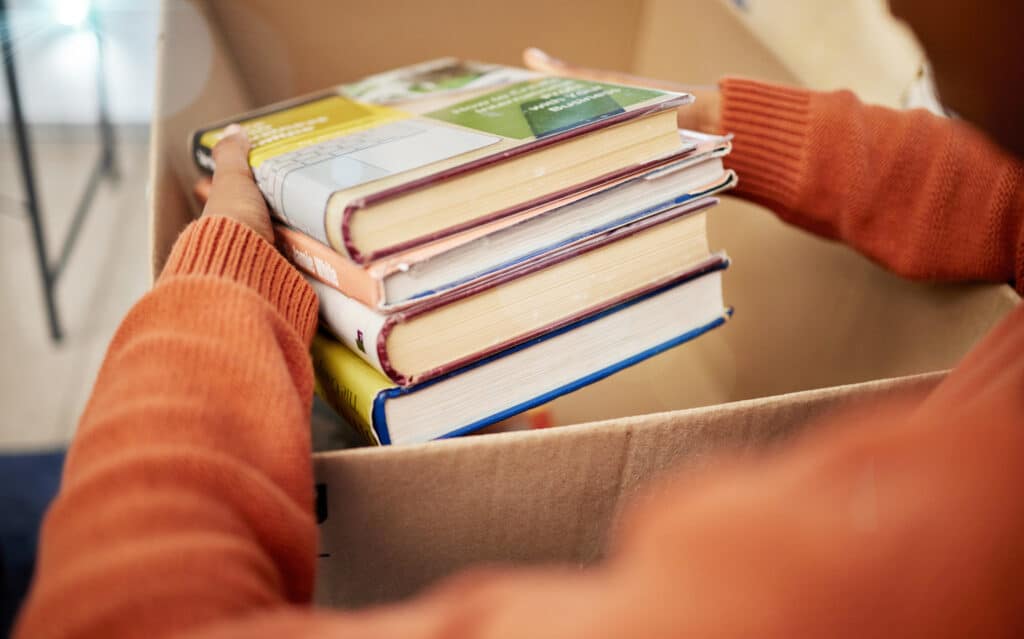
Most people know that moving books is one of the heavier jobs in a move, but it doesn’t need to be as difficult as some people make it. If you have a large collection and value your books, many people also don’t realise that it’s easy to damage books during a move, even though we think of them as robust items. They need special attention before you pack them into boxes, so let’s look at the process for moving books safely.
- Box selection
The first mistake many people make is not choosing the right boxes, specifically boxes that are too large. On their own, books aren’t heavy, but as soon as you pile a few into a box, it gets heavy fast.
The rule of thumb for any box packed for moving is that it should be no heavier than one person can comfortably manage. This means bending or squatting to pick it up, carrying it to the truck and loading it. For this reason, you should always use small boxes for books, as an overloaded box is a classic plot for getting injured.
- Gather your packing materials
To pack books safely and correctly, you will need:
- Small, strong boxes.
- Packing tape for moving boxes.
- Light space-filling materials such as packing paper, bubble wrap or packing peanuts. You can also use old linen or clothing items like balls of socks.
- Scissors to cut the tape and a permanent marker to label boxes.
- Sort and clean your books
Books have a habit of gathering dust, so you’ll need to carefully remove them from your shelves and dust them off before packing. If you don’t clean them, any dust between books will rub against the covers while the books are on the truck and scratch the covers. Glossy paperbacks or dustcovers on hardbacks will quickly lose their shine.
- Assemble your boxes
Assemble your boxes following the usual method of taping the bottom seam and open side seams, but for any boxes containing books, use more layers of tape than normal to give the box strength. We recommend several strips to cover the centre seam, extra strips either side of the centre, and enough tape to secure the side seams. The famous idiom “the bottom fell out” may well have come from people who didn’t use enough packing tape on their boxes of books.
- Loading your boxes
While many people think you simply have to fill a box with books to load it, there is actually some science involved with loading boxes correctly. Specifically, we’re concerned with creating a low centre of gravity in each box. Keeping the centre of gravity low makes the box easier to lift, carry and stack. If the centre of gravity sits at one side of the box or at the top, the box will want to ‘fall’ in that direction.
How to create a low centre of gravity
- Select your heaviest books for the bottom of each box. These are usually large, hardcover books like an encyclopaedia, atlas or coffee table book.
- Place the heavy book face down in the box at the centre if possible. Don’t worry if you have small gaps at the sides, and don’t fill those spaces with books positioned on their spines.
- Stack one or two more heavy books at the bottom and then fill the box with lighter books like paperbacks.
- Leave a little space at the top rather than cramming in as many books as possible. This helps to keep the centre of gravity low.
- Fill your empty spaces with your lightweight packing materials so the books are positioned as securely as possible.
- Like the bottom of the box, don’t be shy with the packing tape to secure the top.
- Label your boxes
There are many ways to label boxes according to your preferences for finding and unpacking what you want at your new home. Regardless of how you label your book boxes, write ‘HEAVY’ in bold letters for whoever has to lift and carry them.
Congratulations. You’ve packed your books correctly. Once the move is over and you’ve done your unpacking, is there any better way to relax than with a good book?