
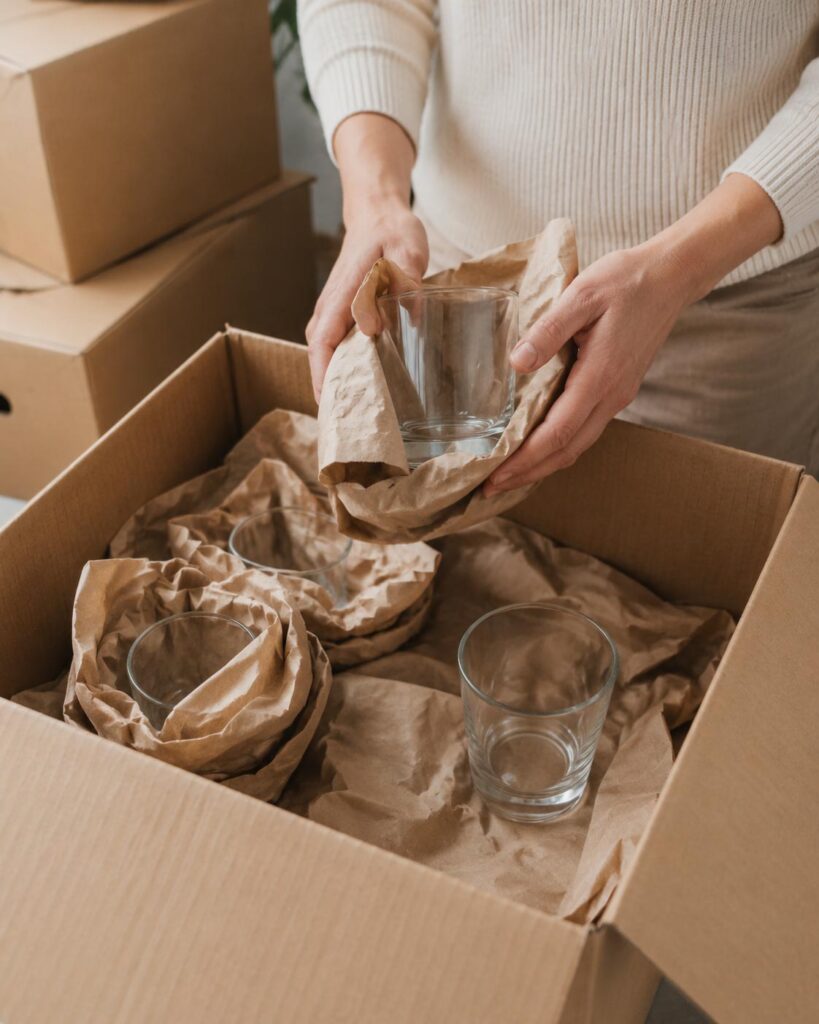
When you’re packing glassware to move house, it’s important to use good packing materials and techniques. Especially with large pieces of glassware, like bowls, bottles or vases, you’ll significantly reduce the chances of a chip, crack, scratch or complete breakage if you take the time and effort to pack each piece well.
Read on, and we’ll break down the process, not your glassware, step by step.
1. Invest in good packing materials
We recommend you use the following materials:
- Medium, double-walled moving boxes.
- Good quality bubble wrap.
- Packing and tissue paper.
- Packing tape and regular tape.
- A permanent marker pen.
2. Clean before you pack any glass
Glass is as susceptible to scratches as it is to chips, cracks and breakages. If any item has even a fine layer of dirt or dust, the motion of the moving truck can create rubbing, even for well-packed items. Dirt and dust then act like fine sandpaper, putting scratches or dulling the shine on the surface through abrasion.
Clean each item by washing off any dirt and dust, then dry it completely with a soft cloth before proceeding to packing.
3. Protect each item inside and out
Glass gains more impact resistance if you protect it inside and out. To protect the inside, gather your tissue paper and scrunch it into balls. Fill the interior so there’s a firm, but not tight, mass of tissue inside. This improves the structural integrity of the glass, and stronger is always better protection.
4. Protect the outside
Gather your sheets of bubble wrap. Each sheet needs to be big enough to completely wrap the outside, top and bottom of the glass. Place the item on its side against the edge of the sheet and use regular tape to attach the sheet to the glass. Packing tape, being stronger, may leave sticky residue that’s hard to clean off, so stick with regular tape.
Now roll the item into the bubble wrap to completely cover it. Secure the package with tape on the sides, top and bottom. This will stop the bubble wrap from becoming loose and reduce movement within the package.
5. Assemble your box
Double-walled boxes are the best choice for any breakables because they have the most impact and crushing resistance. Be generous with your packing tape when you seal the bottom middle and open side seams of the box. Use several strips of tape for each seam, offsetting each strip of tape to create a wider, stronger seal.
6. Create a soft layer at the bottom of the box
Make an even, soft layer at the bottom of the box without any gaps. You can use anything soft, like an old cushion, folded towels or blankets. Balls of packing paper also work well.
7. Pack your glassware
The most common mistake people make when packing glassware is to put it on its side in the box, usually because it looks like it fits better. However, glass is strongest standing up and much less likely to break compared to glass packed on its side. Don’t overfill the box so you can create cushioning with scrunched packing paper when you fill the gaps. Put a soft layer on top, like you did on the bottom, and you’re ready to seal your box.
8. Sealing and labelling
Again, use several offset strips of packing tape to seal the top middle and side seams of the box. You’ll now have a package with solid structural integrity that will stand up much better to bumps or accidents. Get your pen and mark it GLASSWARE, FRAGILE and TOP LOAD.
With glassware, it’s also prudent to add an arrow and THIS WAY UP so whoever loads it onto the truck doesn’t undo all your hard work by putting the box on its side.
And that’s it! You’ve given your glassware the best chance of a safe journey to your new home.