
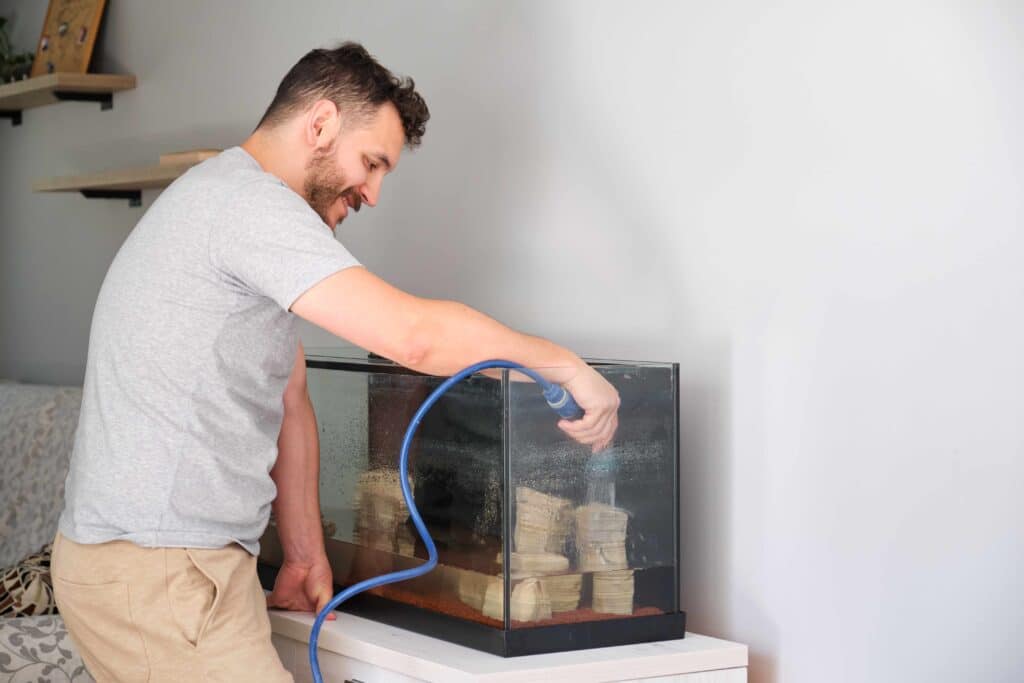
Moving a fish tank is a time-sensitive operation that adds extra complexity to moving day. Unlike other pets, which can be moved at your convenience, every aquarium develops a unique biome that supports your fish. This means you have a short window of opportunity to remove them from that biome without putting them at risk.
We all have a lot on our plate on moving day, but if you have an aquarium, you will need to plan ahead and prepare so you have time to move your fish safely and without putting yourself under unnecessary stress.
Vital points to consider in your planning:
- Ensure your fish are out of their tank for the shortest time possible, ideally a few hours at the most.
- A large fish tank is heavy and awkward to handle, so make sure you can move it efficiently and safely.
- Remember to tell your movers the fish tank is a LIFO item: last in, first off. You’ll want to re-establish your tank as a priority when you reach your new home.
- Decide where you will place your tank in your new home before you move.
How far are you moving your fish tank?
Taking the first point above into account, that you shouldn’t have your fish out of their tank for more than a few hours, you’ll have to decide if it’s feasible to take them as part of your move. Any long-distance move will put your fish at extreme risk, so it’s best to rehome them. Many pet stores rehome fish, so ask around to find the store closest to you.
There are no cheats or hacks for moving a fish tank
You wouldn’t be alone if you came to the conclusion that moving the tank as a whole bypasses the time-critical risk of removing your fish from their home. Unfortunately, this is even riskier for you and your fish.
- Tanks filled with water are heavier.
- In transit, a full tank can shatter from the vibrations.
- Professionals won’t carry a full tank for the above reasons.
The process for moving day
- Remove your fish
Fill appropriate containers with clean water and remove your fish from the tank. Once you have done this, the timer starts. Stay calm and don’t rush. Put your fish in a safe place, away from heat or direct sunlight. For their protection, don’t pack them in the car until you’re ready to go.
- Remove the decor
Remove any ornaments from the tank and give them a good clean, but don’t use chemicals that could contaminate the tank. Dry the ornaments and pack them into a box.
- Remove living plants
Prepare appropriate containers with clean water for your plants and transfer your plants into them. Put these with your fish for loading into the car.
- Remove the pump
Pumps are fragile pieces of equipment and require the same care and handling as any other breakable item. Unplug your pump, clean it if necessary and wrap it with the same care as a fragile item, with bubble wrap or a similar protective wrapping. Pack it into a box and ensure you label it so you can find it immediately.
- Remove the water
Get a large container or bottle and take a sample of the water from your tank. This water contains the biome of the tank and helps to quickly re-establish it again once you have relocated your tank to your new home. Then drain the remaining water.
- Remove the pebbles
If you have pebbles at the base of the tank, remove them, rinse them and pack them into a sealed container.
- Disassemble and clean the tank
Especially if you have a large aquarium, disassemble as much as you can to make packing and handling easier. Use this opportunity to give your tank a good clean and a thorough dry with a towel.
- Pack the tank
Tape each face of the glass with an X from the top corner to the opposite bottom corner to give it more structural strength. Don’t skimp on the padding when you pack your tank. If you’re boxing it, fill every space between the tank and the box with padding to protect it from knocks. Seal the box and mark it fragile.
- Relocating your fish tank
Once you arrive at your new home, reassemble your tank and replace all the pebbles, plants and ornaments. Replace the pump and plug it in. First add the water sample you removed before filling the tank with clean water. Turn on the pump and allow the water to circulate and oxygenate for at least five minutes. Then return your fish to their home, sit back and enjoy the view.